Video Solution
By David Zhou
Note: The video solution might not be the same as other solutions. Code in C++ and Java.
Solution
Explanation
Since the enclosures must be rectangular, there must be a vertical or horizontal line that separates the two. Otherwise, we'd have a case where one enclosure would have to overlap the other in order to enclose all the cows.
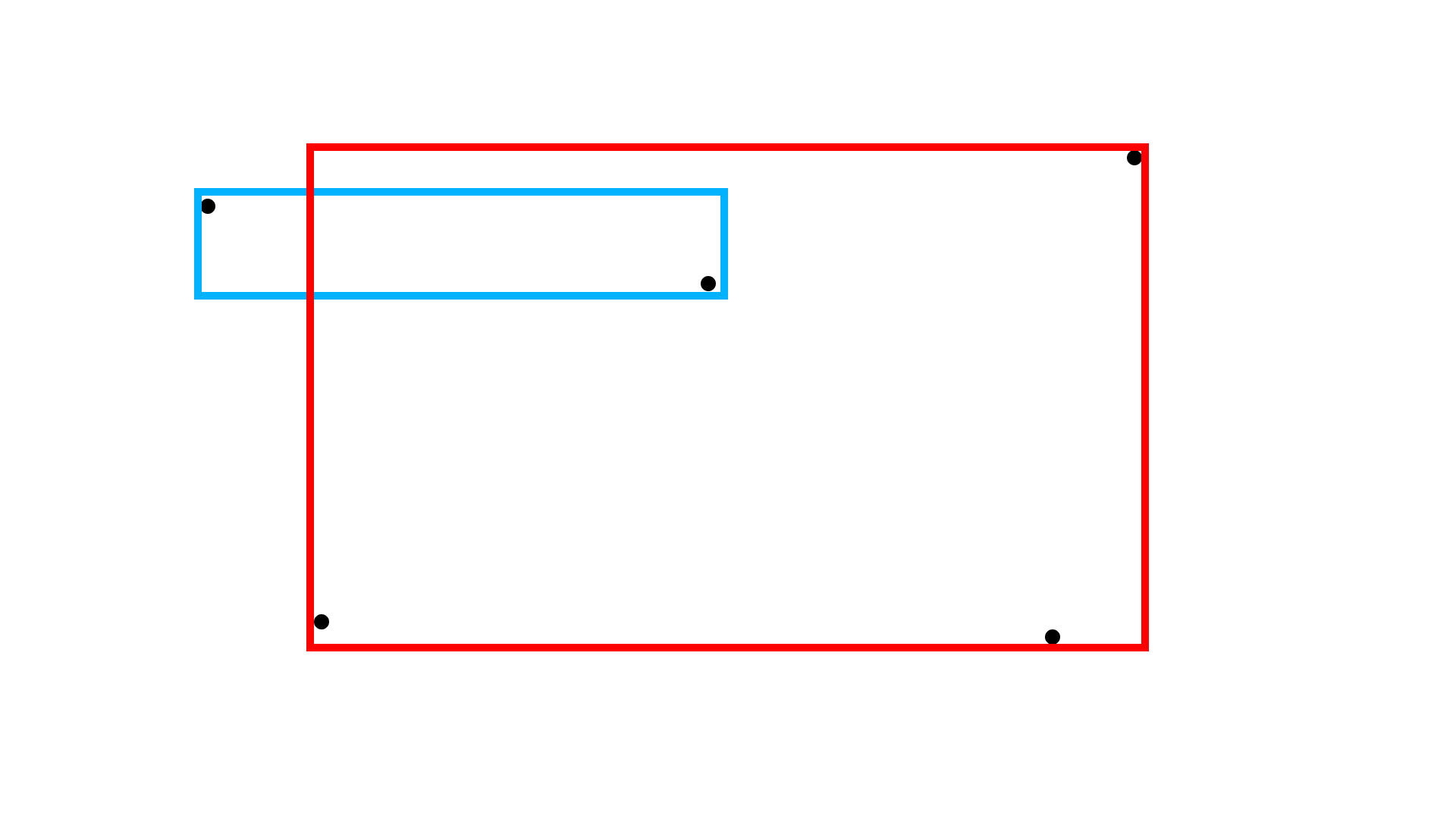
Thus, we'll perform two sweeps, one checking vertical splits, and the other checking horizontal splits. To keep track of the best answer, we'll keep prefix and suffix minimums and maximums to calculate each possible solution in time.
We can also use a binary search tree instead of prefix/suffix minimums and maximums. To do this, we can create two ordered sets: a set representing the current enclosure, and a set representing the other enclosure. As we sweep across these coordinates, we'll add them to the current set and remove them from the other enclosure. To query, we'll fetch the minimum and maximum values from the sets.
Some accepted submissions may give different outputs on the following test case:
The right answer should be .
Code Snippet: Test Case (Click to expand)
Implementation
Time Complexity:
with open("split.in") as read:n = int(read.readline())cows = [list(map(int, read.readline().split())) for _ in range(n)]ans = 0def search():"""returns the maximum area saved by testing splits along cows[i].first
Join the USACO Forum!
Stuck on a problem, or don't understand a module? Join the USACO Forum and get help from other competitive programmers!