| Resources | |||||
|---|---|---|---|---|---|
| cp-algo | Well documented article. | ||||
The Catalan numbers are a sequence of positive integers that can be very useful in counting problems in combinatorics. The -th Catalan can be expressed as follows using binomial coefficients:
They also have the recurrence formula
which can also be expressed as
The first Catalan numbers are
| n | 0 | 1 | 2 | 3 | 4 | 5 |
|---|---|---|---|---|---|---|
| 1 | 1 | 2 | 5 | 14 | 42 |
Applications
The Catalan numbers can be used to represent a wide variety of things.
For example, is equal to the number of valid parenthesis expressions of length . Take, for instance, :
()()()(())()()(())((()))(()())
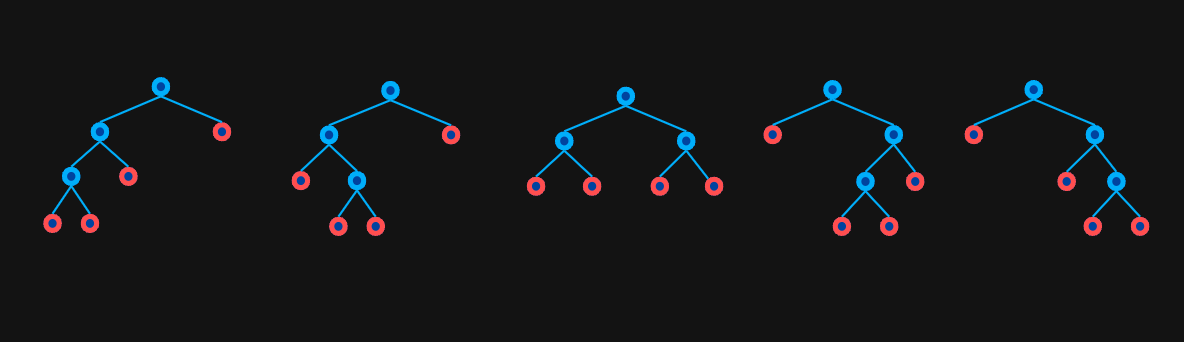
It's also equal to the number of full binary trees with leaves. The following image shows the binary trees with leaves:
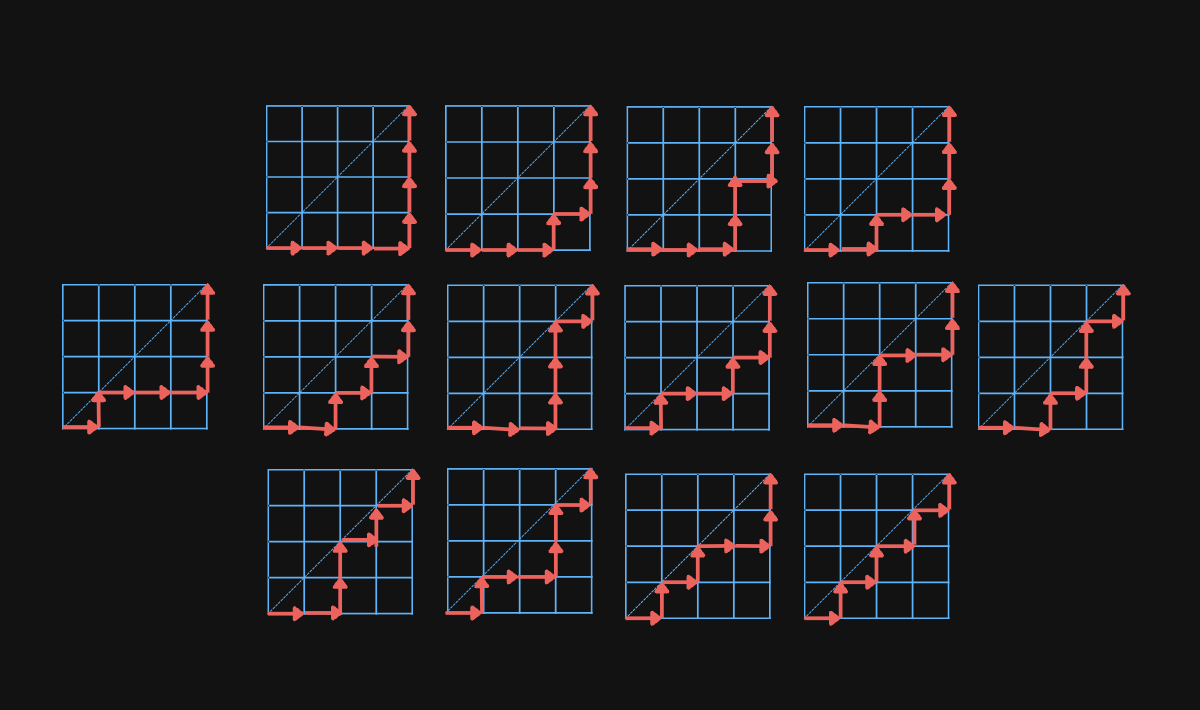
is also the number of monotonic lattice paths along the edges of a grid that don't pass above the diagonal. The paths start in the lower left corner and ends in the upper right corner.
For example, there are paths in a grid:
The next two examples are a bit more niche, but they're still interesting to think about.
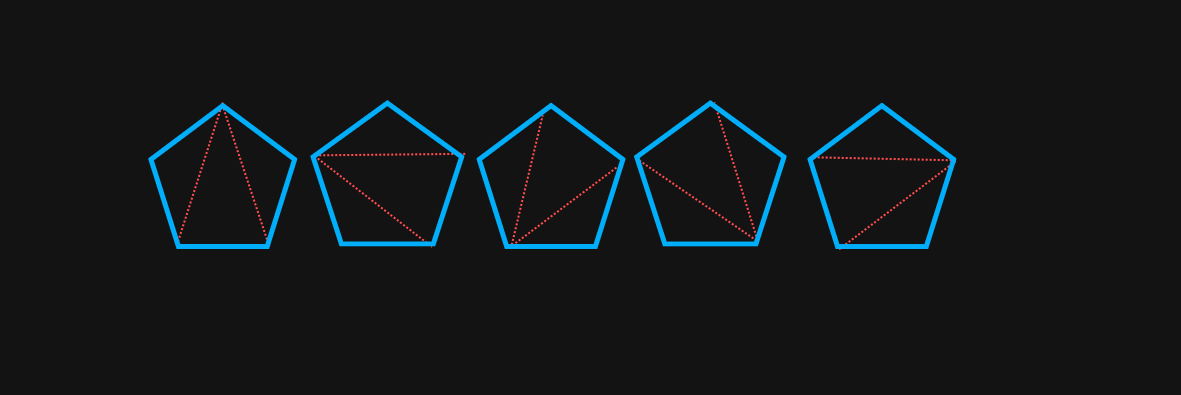
Consider a convex polygon with sides divided into triangles by connecting vertices with non-intersecting lines. The number of different ways to divide the polygon in this way is equal to .
Here's the particular case for in which we have :
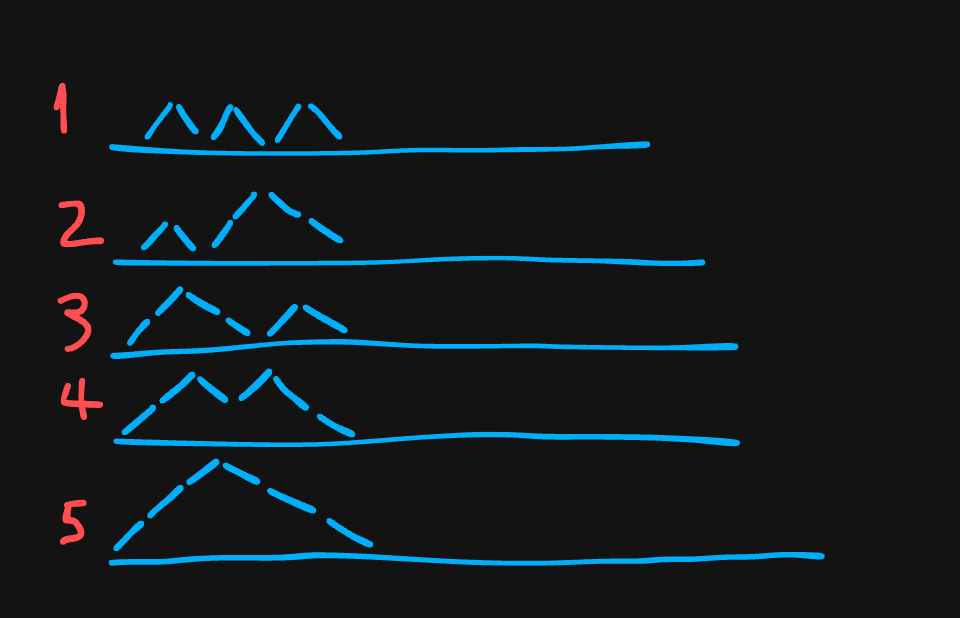
is also equal to the number of mountain ranges of length consisting of upstrokes and downstrokes.
Derivations
Using the "mountain ranges" interpretation, we can derive two nice bijective proofs for the Catalan formulas.
Reflection
Consider complementary counting: we then need to characterize the paths that dip below ground level, i.e. the paths that touch the line . It turns out that for every such path ending at , we can biject it to a path ending at by reflecting a portion of the path, like so:
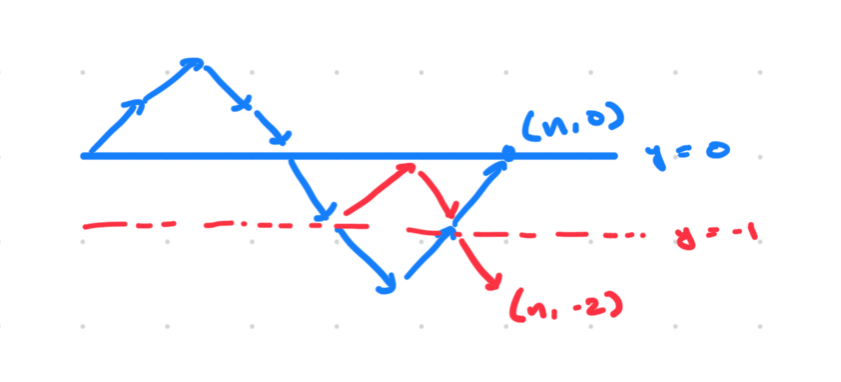
To be precise, the bijection is defined as follows:
- To go from blue to red, we reflect the blue path about the first point that touches the . Since we assumed the blue path touches at least once, this point is guaranteed to exist.
- To go from red to blue, we also reflect the red path about the first point that touches . This point is guaranteed to exist because the path starts at and ends at , which means it must cross at some point.
Therefore, the number of blue paths equals the number of red paths, and the number of red paths is easy to count:
Thus, the number of mountain ranges is the total number of paths minus the number of blue paths:
Note that we can generalize this bijection: to count the paths that cross , we can instead count the number of paths that end at .
Exceedance
This explanation offers more insight into why appears in the final expression.
First, let's define the exceedance of a path as the total number of upstrokes it takes above .
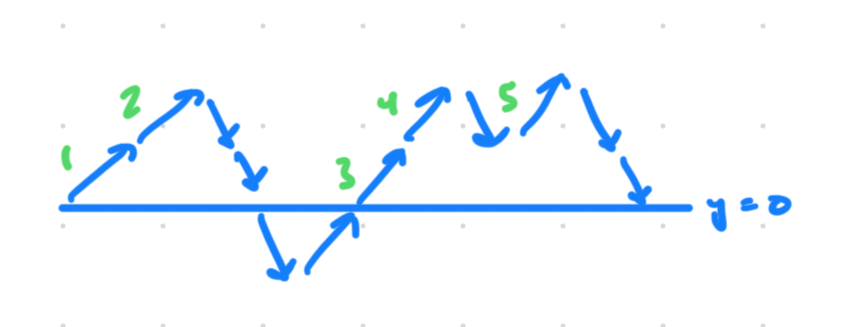
A path with exceedance 5.
The core result is that for all from to , the number of paths with exceedance is equal. Therefore, the number of mountain ranges, i.e. the number of paths with exceedance , is precisely of the total number of paths.
To prove this equality, we will define a bijection between paths with exceedance and paths with exceedance for . Let's consider the following mapping: for a path with exceedance , we take the last downstroke that goes from to and move it to the end of the path.
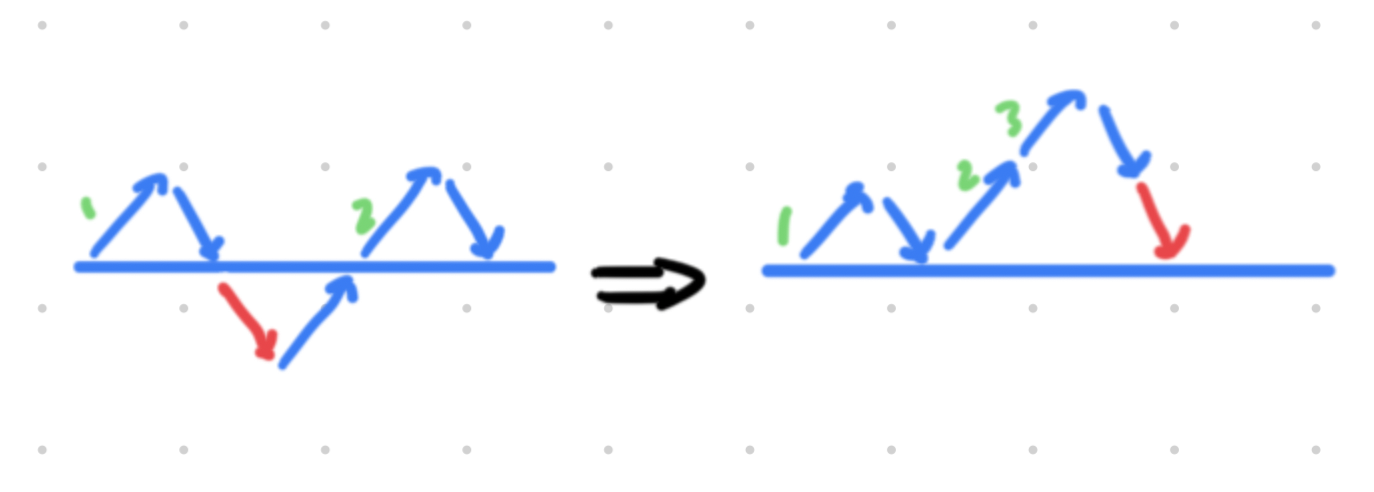
This transformation indeed increases exceedance by 1, but unfortunately it is not bijective. One easy way to see this is the fact that the resultant path always ends in a downstroke, which clearly does not cover every possible path of exceedance .
Thankfully, we can make an easy fix: after applying our current mapping, just swap the second half (i.e. the part originally after the red arrow) of the path with the first!
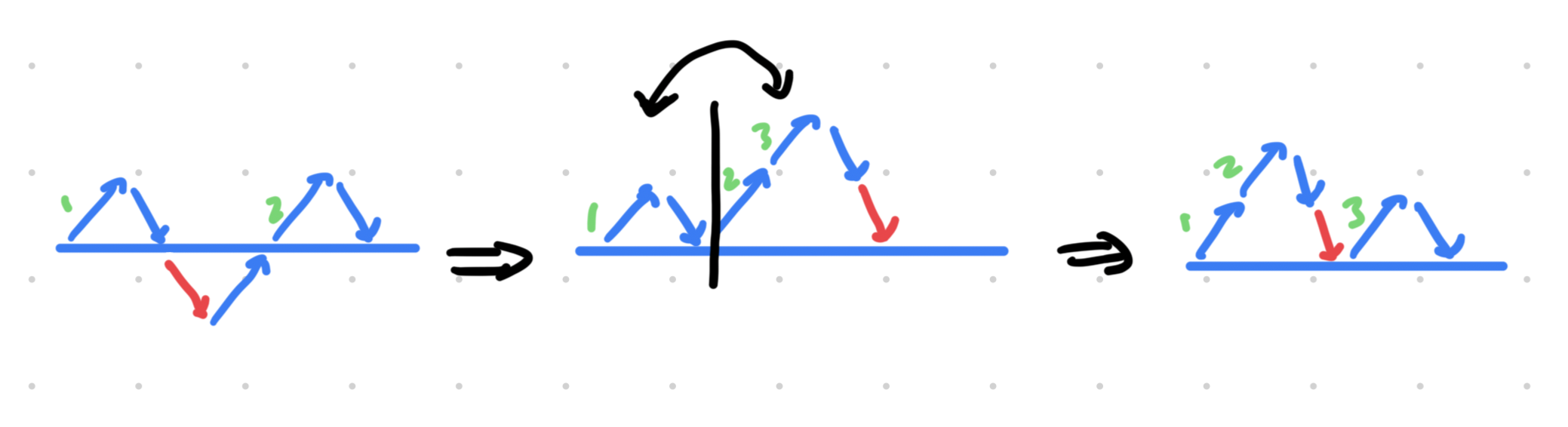
We can show that this mapping is invertible by verifying that it transforms the red arrow from the last downstroke from to , to the first downstroke from to . Therefore, we have established a bijection between paths with exceedance and paths with exceedance , as desired.
Just for fun, here's an image from Wikipedia that demonstrates how this algorithm decreases the exceedance of various paths:

Bracket Sequences I
Focus Problem – try your best to solve this problem before continuing!
Explanation
The problem is a direct application of Catalan numbers. The answer for is the Catalan Number.
Implementation
Time Complexity:
MAXN = 10**6MOD = 10**9 + 7fac = [0] * (MAXN + 1)inv = [0] * (MAXN + 1)Code Snippet: Combinatorics Functions (from the module) (Click to expand)n = int(input())
Problems
| Status | Source | Problem Name | Difficulty | Tags | ||
|---|---|---|---|---|---|---|
| LC | Easy | Show TagsCatalan, Combinatorics | ||||
| SPOJ | Medium | Show TagsCatalan, Combinatorics | ||||
| CSES | Hard | Show TagsCatalan, Combinatorics | ||||
| CF | Hard | Show TagsCatalan, Combinatorics | ||||
Module Progress:
Join the USACO Forum!
Stuck on a problem, or don't understand a module? Join the USACO Forum and get help from other competitive programmers!